Spray foam software for the proportioner-down, substrate-cold, credit-math-wrong day
Quote open-cell vs closed-cell on site with IRA 25C credit and utility rebate already subtracted. Verify substrate temp before the gun fires. Document foam thickness at four points per cavity so the HERS rater callback never gets past your first sentence.
$1 for 14 days, then $19/mo. Card required. Cancel any time.
The $1 trial is Starter. Dispatch, two-way texting and job costing are on Crew ($39/mo).
From $19/mo, users included. Verified competitor prices·CSV import from Housecall Pro, Jobber and ServiceTitan·No per-seat fees, ever
Features spray foam contractors use
Built for spray foam insulation contractors
Five things decide whether you close the $14,800 unvented attic encapsulation or watch it go to the next rig on the block. On-site quotes with open-cell, closed-cell, and hybrid pricing built in. IRA 25C credit and utility rebates entered as line items on the quote. Substrate temp recorded before the B-side hose heats up. Foam thickness documented at four points per cavity. Ad spend tracked to the signed contract. One app. No spray foam upsell.
On-Site Quotes with Open, Closed, and Hybrid PricingStarter
Walk the home. Photograph the attic, walls, crawl, and rim joist. Work out the R-value target per cavity, R-49 for a zone 5 attic, R-19 wall, R-30 crawl, and build the price book line items for open-cell at $1.10/board-foot (R-3.7/inch, 3.5 lb density, right for interior cavities and sound control), closed-cell at $1.85/bf (R-7.0/inch, 2.0 lb, for unvented roofs, below-grade, and flood-prone foundations), or a hybrid with a 2-inch closed-cell base and open-cell fill to depth. Build the quote in eight minutes, add the IRA 25C credit and utility rebate as optional line items, and the customer accepts it and pays a deposit through Stripe before you back out of the driveway.
R-Value Reference Per CavityStarter
Open-cell runs R-3.7 per inch. You need 13.5 inches to hit R-49. Closed-cell runs R-7.0 per inch, seven inches gets you there. Put your own cavity-depth targets on the quote and verify the install with a depth gauge photo at four reference points on the job. You stop spraying 8 inches of open-cell and delivering an R-29 attic to a customer whose contract says R-49.
Spray Foam Rig and Crew Dispatch with Substrate TempCrew
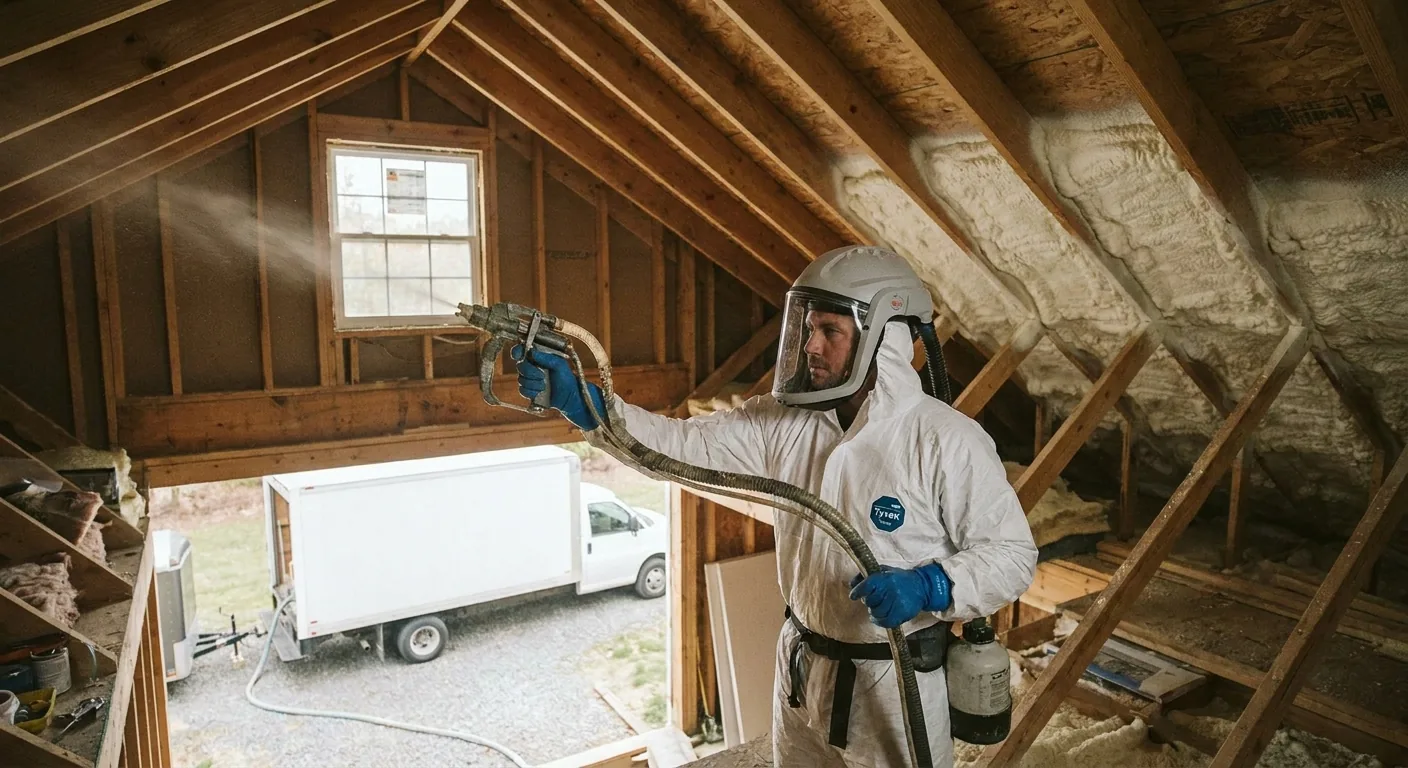
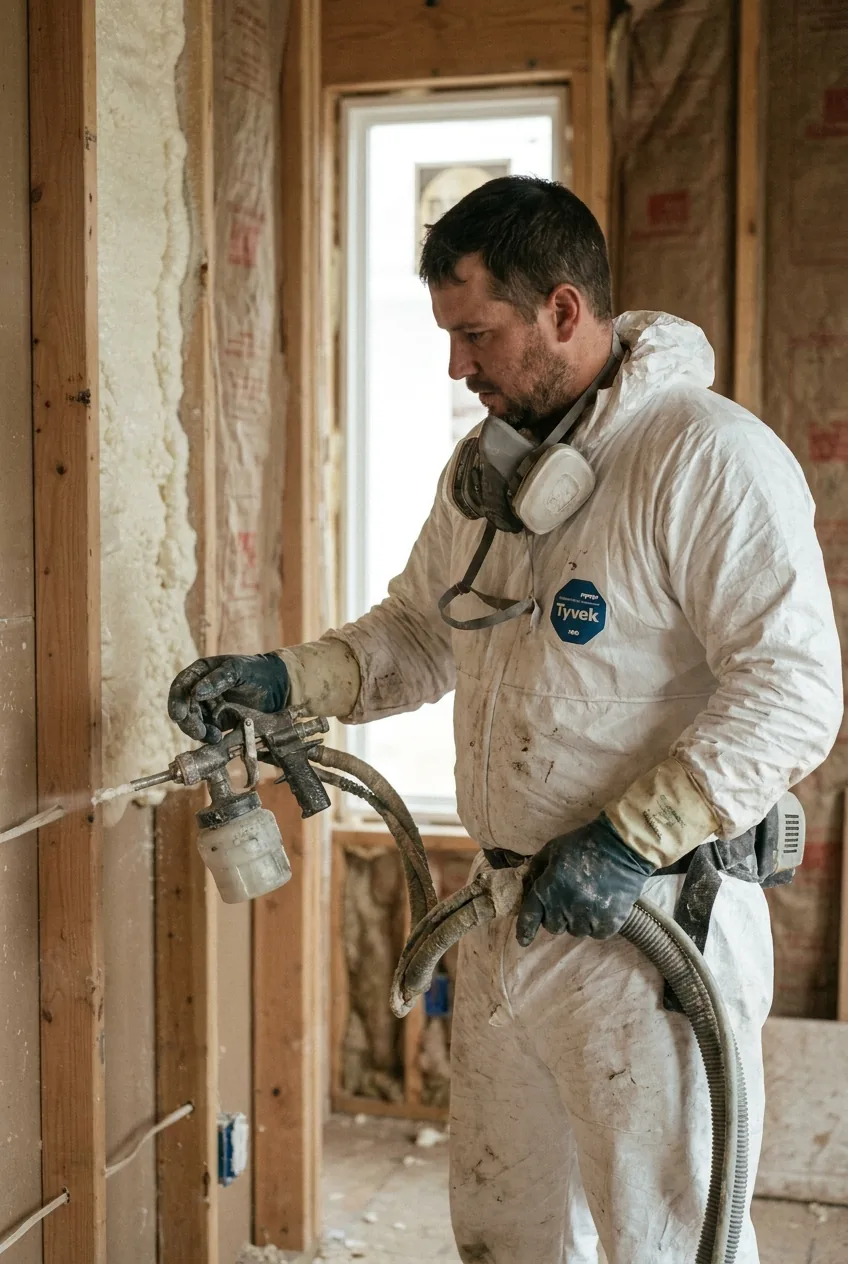
Dispatch sends the rig, Graco E-30, PMC AP-2, or equivalent, along with your crew, air monitoring gear, Tyvek, and P100 half-face respirators. Before the heated hose warms and the gun fires, the tech records the substrate temp from an infrared thermometer on a custom job field. Manufacturer spec is 60 to 80 degrees. Below 60 degrees in a Boston February attic, the SPF Heat-Wrap method kicks in: propane salamander heater, insulated wraps, substrate brought to 65 degrees first. You don't spray a 38 degree substrate and find out what exothermic scorching costs you when the demand letter arrives.
Photo Records of Foam Thickness and CureCrew
Pre-spray: cavity photos and a logged substrate temp reading. During: foam application photos at each cavity with a depth gauge at four reference points, recording that R-49 means 13.5 inches of open-cell or 7 inches of closed-cell. Post-spray: 24-hour cure photos showing bond, no scorching, no shrinkage. If a callback comes in Year 3, you have the install record showing the substrate temp, thickness, and cure photos from the first day on the job.
Google Ads and Lead Source ROIBusiness
Spray foam keywords run $30 to $70 a click. Claver captures the click ID and tracks it through quote, signed contract, and final payment. For example, "spray foam attic Boston" might bring 14 clicks, 9 quotes, and 3 signed jobs worth $44,400, while "spray foam contractor near me" brings 78 clicks and one $4,800 job. Put the budget where the numbers say it is working.
Starter is $19/mo. Texting, AI and dispatch start on Crew at $39. The phone line and AI receptionist are on Business at $79.
Why spray foam contractors switch
Why spray foam insulation companies choose Claver
Physics that will bite you
Spray foam is a high-ticket trade with physics that will bite you. The foam manufacturer requires 60 to 80 degree substrate temperature for proper bond and cure. Spray on a 38 degree attic deck in February and you get failed bond, exothermic scorching, off-gassing that lingers for years, and a $14,800 reapplication when the demand letter arrives.
The shops that keep their margins do two things differently. They record substrate temp before the gun touches the B-side hose. They document foam thickness at four reference points per cavity so the R-value claim holds up when the blower-door test and the HERS rater show up together.
Substrate temp record-keeping is the engine. Foam thickness documentation is the insurance policy on the warranty.
Walk a 1968 Boston attic on a Saturday morning and the proposal comes together fast in the app. Photograph the existing fiberglass batts, R-19 settled to R-13 effective from compression and air leakage, plus the kneewalls, sloped ceiling, flat ceiling, can lights, and chimney chase. Measure the roof deck surface area for unvented encapsulation. Customer picks open-cell at the roof deck, R-49 target. That is 13.5 inches of open-cell at R-3.7 per inch, the right call for Massachusetts zone 5 IECC requirements and for an attic that will eventually become conditioned space. The quote runs $14,800 for materials and a two-person install with SPF Heat-Wrap method to bring the substrate from 38 degrees to 65 degrees before the Graco fires, air monitoring, and an 18% margin. Add the IRA 25C insulation credit at $1,200 and the Mass Save unvented attic encapsulation rebate at $2,400 as line items. Net to the customer: $11,200. She accepts the quote on the tech's iPad. Pays a $2,800 deposit. Materials go out Monday. Install is Saturday two weeks out, after the forecast confirms a workable substrate-temp window.
The substrate temp window
That substrate temp window matters more than most contractors admit. Demilec, Icynene, BASF, all require 60 to 80 degrees at the substrate. A Boston attic in February typically reads 32 to 42 degrees. Spray closed-cell at 38 degrees and the exothermic reaction superheats with no thermal mass to absorb it. The foam hits 350 degrees internally and degrades. Open-cell at that temp fails to bond: cold substrate causes premature gelling at the interface, and within six months the foam falls off the roof deck. Build a job checklist so the tech logs the infrared thermometer reading before spray begins. Below 60 degrees, that's your cue to run the SPF Heat-Wrap protocol or move the job on the calendar. You don't spray cold and find out in 18 months what that decision cost.
Year 2. The customer's HERS rater shows up for a blower-door test tied to an energy-efficient mortgage refinance. She runs thermal imaging and flags three areas where the insulation looks thinner than 13.5 inches. Customer calls saying her R-value is below the contracted R-49. You pull up the install record: foam thickness at four reference points per cavity, south-side roof deck 13.4 inches, north-side 13.6 inches, east and west both 13.5 inches. Average thickness 13.5 inches, which works out to about R-49.95 at R-3.7 per inch. The thermal imaging anomaly is rafter framing, 2x12 lumber at R-1.5 per inch effective versus the foam at R-3.7. The framing reads colder. The foam between framing is spec. Customer accepts the explanation. Job stays under warranty. No re-spray.
Which scope pays
Job costing tells you which scope pays. Your $14,800 unvented attic encapsulation runs 41% margin, one-day install, one rig setup, open-cell material at the lower board-foot cost. Your $24,000 hybrid install at two inches of closed-cell base plus open-cell fill to R-49 runs 28%, because closed-cell raw material costs $1.85 per board-foot and the job needs two passes with a rig reset between them. Now you know which scope to push when a homeowner is on the fence.
Most spray foam contractors are completely blind on ad spend. You are paying $30 to $70 a click. Some of those clicks become $24,000 hybrid encapsulation jobs. Some become nothing. Claver captures the Google click ID at site visit and follows it through quote, signed contract, and final payment. For example, "spray foam attic Boston" might bring 14 clicks, 9 quotes, and 3 signed jobs worth $44,400, while "spray foam contractor near me" brings 78 clicks and one $4,800 job. Move the budget. Stop guessing.
Cancel anytime. 20-minute migration from your current tool.
Pricing
Pricing that works for spray foam contractors
$19/mo to start with on-site quoting and R-value reference pricing. $39/mo for growing teams with texting, AI, dispatch, and job checklists for substrate temp and thickness documentation. $79/mo for the full toolkit with the phone line and Google Ads tracking. Same plans as every Claver page, no spray foam upsell.
Simple pricing, users included
Every plan includes unlimited jobs, quotes, invoices, and Stripe payments. Texting, AI, dispatch and job costing start on Crew. The phone system and full back office are on Business.
Starter: $1 for 14 days, then $19/mo. · Cancel anytime · Your data exports as CSV
Common questions
Common spray foam software questions
No marketing dance. The questions spray foam contractors ask before they sign up.
Does Claver build on-site quotes with open-cell vs closed-cell vs hybrid?+
Yes. Walk the home, photograph attic, walls, crawl, and rim joist. Work out the R-value target per cavity, R-49 attic, R-19 wall, R-30 crawl, and price it with open-cell at $1.10 per board-foot (R-3.7/inch, 3.5 lb density, right for sound control and interior cavities), closed-cell at $1.85 per bf (R-7.0/inch, 2.0 lb, for unvented roofs, below-grade, and flood-prone), or hybrid with a 2-inch closed-cell base and open-cell fill. Build the quote in eight minutes and add the IRA 25C credit and utility rebate as line items. Customer accepts the quote and pays a deposit through Stripe before you back out of the driveway.
Does it verify substrate temperature before spray?+
Yes, you record it. Spray foam manufacturer specs, Demilec, Icynene, BASF, all require 60 to 80°F substrate for proper bond and cure. Build a job checklist so the tech logs substrate temp from an infrared thermometer before the heated hose warms and the gun fires. Below 60°F and the SPF Heat-Wrap method kicks in: propane salamander heater, insulated wraps, substrate brought to 65°F. You don't spray a 38°F attic deck and find out what exothermic scorching costs eighteen months later.
Does it document foam thickness at 4 reference points per cavity?+
Yes. Build the install around timestamped photos: pre-spray cavity and substrate temp reading, during-spray application photos at each cavity with a depth gauge at four reference points (R-49 = 13.5 inches open-cell or 7 inches closed-cell), and post-spray 24-hour cure photos showing bond, no scorching, no shrinkage. When a HERS rater flags a thermal anomaly in Year 2, you pull up the install record. Average thickness 13.5 inches at R-3.7/inch works out to about R-49.95. The anomaly turns out to be rafter framing. Job stays under warranty.
Can I import customers from JobNimbus, ServiceTitan, or Housecall Pro?+
Yes. Export your customer list as CSV from JobNimbus, ServiceTitan, Housecall Pro, or FieldEdge, then upload it to Claver. The wizard maps the columns. Most spray foam contractors finish the migration in 30 to 45 minutes. The historical project and rebate data takes a little longer than other trades. If anything looks off, email [email protected] and we'll sort it personally.
What does Claver cost for a spray foam contractor?+
$19/mo for Starter (2 users), with on-site quoting and R-value reference pricing. $39/mo for Crew (8 users) when you want texting, AI, the dispatch board, and job checklists for substrate temp and foam thickness documentation. $79/mo for Business with the phone line and Google Ads conversion tracking. No contract. Cancel anytime.