Hood cleaning software with NFPA 96 compliance photos built in
Run a 14-restaurant Tuesday-night route after close. Auto-bill the NFPA 96 quarterly recurring service. Document every cleaning with timestamped photos so you have the record ready the next time an auditor asks.
$1 for 14 days, then $19/mo. Card required. Cancel any time.
The $1 trial is Starter. Route optimization, two-way texting and job costing are on Crew ($39/mo).
From $19/mo, users included. Verified competitor prices·CSV import from Housecall Pro, Jobber and ServiceTitan·No per-seat fees, ever
Features hood cleaning shops use
Built for kitchen hood cleaning companies
The 5 things that decide whether you keep the 14-restaurant route for 7 years or lose contracts at the next insurance audit. NFPA 96 quarterly recurring auto-bill, route density that fits 14 restaurants a Tuesday night, timestamped compliance photo records, after-hours dispatch coordination, and per-account history (frequency tier, last service, fire suppression certification status). All in one app. Built for the tech who's cleaned a 32-foot baffle filter exhaust system at a 24-hour Atlanta diner at 3:14am between the dinner rush and the breakfast crew.
NFPA 96 Quarterly Recurring Auto-BillStarter
Customer signs up for the NFPA 96 frequency tier (monthly for solid-fuel grills, quarterly for high-volume restaurants, semi-annual for moderate, annual for low). Stripe pulls the card the day of service. Quarterly $385 × 4 visits = $1,540/year per restaurant. 14 restaurants on Tuesday's route is $21,560/year, billed automatically.
Route Density for 14-Restaurant Tuesday NightsCrew
You note each restaurant's cleaning window on the job (typically 11pm to 5am), and route optimization puts the night's stops in the shortest driving order. Your Tuesday went from 6 restaurants with cross-Atlanta driving to 14 in the same downtown corridor. Same crew. Same fuel. Revenue more than doubled.
Timestamped compliance photo recordsCrew
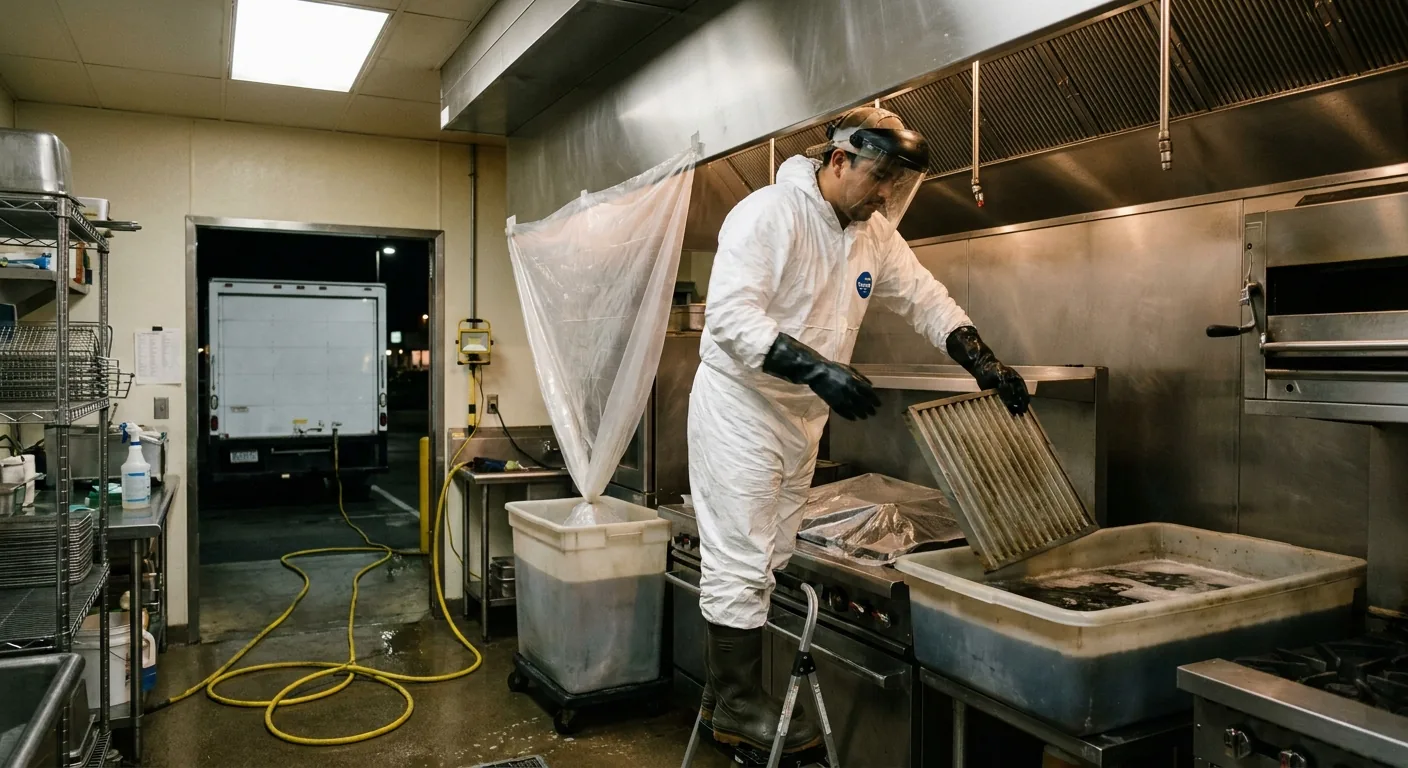
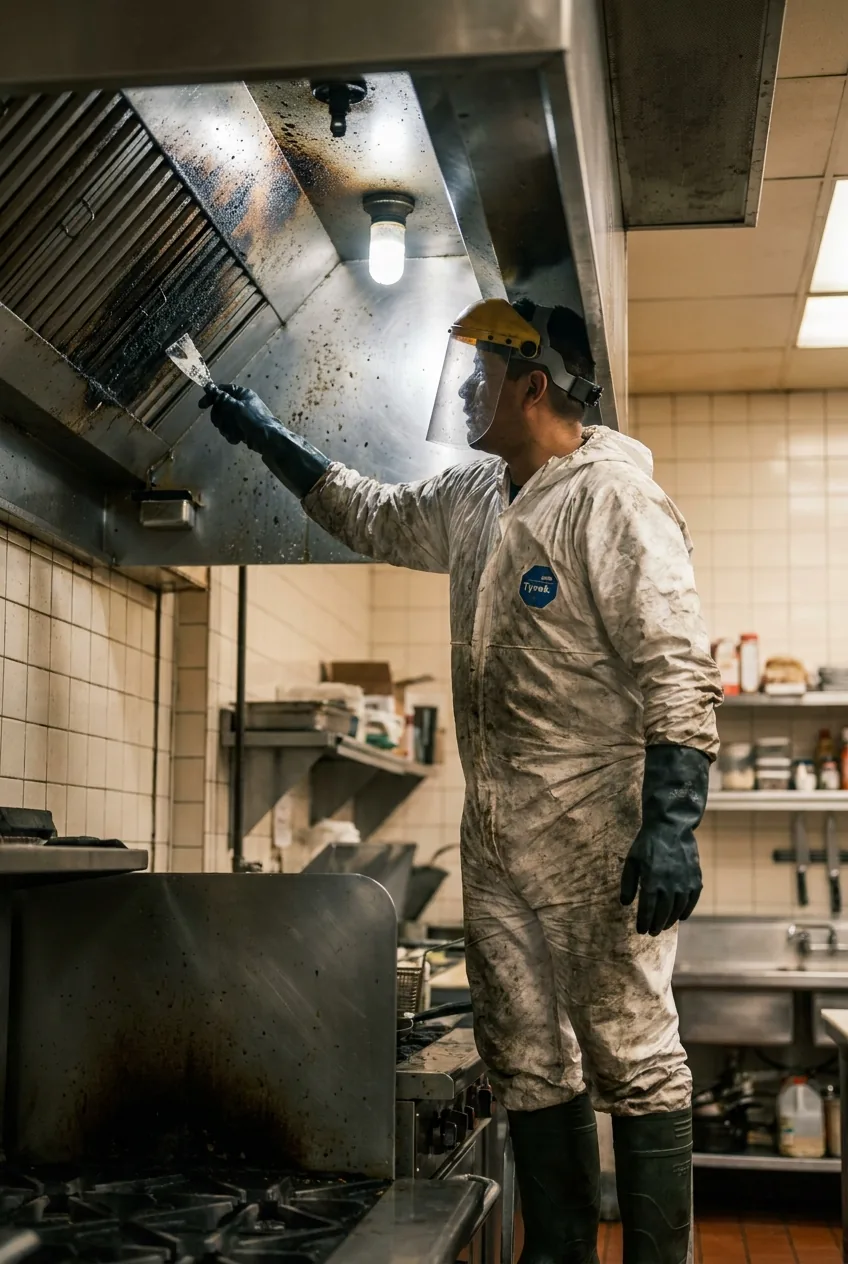
Every cleaning logs photos: pre-service grease accumulation at the hood and ductwork access points and fan housing and roof exhaust, during-service power-washing photos, post-service photos with the NFPA 96 inspection sticker visible (date and tech signature and cleaning grade). When the fire marshal or the restaurant's insurer asks for records, you hand over the iPad with 2 years of timestamped photos instead of digging through a binder in the truck cab.
After-Hours Dispatch CoordinationCrew
Most hood cleaning happens between 11pm and 5am after the restaurant closes. Claver tracks each restaurant's available cleaning window (10pm-6am for the late-night burger spot, 1am-5am for the 24-hour diner that closes for 4 hours, 11pm-3am for the early-close steakhouse). Tech opens the app at 10pm and sees the night's route with each location's specific access window.
Per-Account Compliance HistoryCrew
Each restaurant tracked: frequency tier (NFPA 96 mandates monthly for solid-fuel, quarterly for high-volume, semi-annual for moderate, annual for low), last service date, last fire suppression certification expiration (referred to the suppression company at 11 months), grease accumulation trend (1" max per NFPA 96), insurance carrier on file as a custom field for your own reference. You pull up the full history in seconds the next time the facilities manager or an auditor asks.
Starter is $19/mo. Texting, AI and dispatch start on Crew at $39. The phone line and AI receptionist are on Business at $79.
Why hood cleaning companies switch
Why kitchen hood cleaning companies choose Claver
A B2B compliance business
Kitchen exhaust hood cleaning is a B2B compliance business with brutal regulatory and insurance pressure. NFPA 96 mandates frequency-based cleaning (monthly for solid-fuel grills, quarterly for high-volume restaurants, etc). The fire marshal audits annually. The restaurant's insurance carrier audits at policy renewal. If your compliance documentation is in a binder in the truck cab, you'll lose contracts the next time an audit catches a missed visit.
The shops that win two things differently: they auto-bill the NFPA 96 quarterly cycle (so the customer doesn't shop competitors at any point) and they document every cleaning with timestamped photos so an insurance or fire marshal audit is a quick records pull instead of a scramble through a binder.
NFPA 96 quarterly auto-renewal is the engine. Compliance photo documentation is the survival kit.
When the restaurant signs up for the NFPA 96 quarterly recurring program at $385/visit × 4 = $1,540/year, you set the relationship up for the next 7+ years. Claver schedules step 1 for the customer's preferred Tuesday or Wednesday night quarterly cycle (typically aligned with the restaurant's slow week, late January, mid-April, late July, mid-October). Stripe pulls $385 the night of each service. The restaurant's facilities manager gets a 7-day reminder text before each visit. $1,540/year × 14 restaurants on Tuesday's recurring route is $21,560/year of recurring revenue, $107,800 over 5 years per route, billed automatically. The customer never has to remember to renew.
Route density on Tuesday night
Route density is what turns a 6-restaurant Tuesday night into a 14-restaurant Tuesday night. You record each location's cleaning window, which varies with its close and open times, and Claver's route optimization puts the night's stops in the shortest driving order. Your old Tuesday night: 6 restaurants scattered across Atlanta with 90 minutes of cross-town driving, 6 hours of work, $2,310 revenue. Your Claver Tuesday night: 14 restaurants grouped in the downtown and Midtown and Westside corridor with 22 minutes total drive time, 7 hours of work, $5,390 revenue. Same crew. Same fuel. Revenue more than doubled.
Timestamped compliance photos are what protects your contracts at the annual fire department audit. Build a checklist for every cleaning with photo steps: pre-service photo of the hood and ductwork access points and fan housing and roof exhaust and grease accumulation depth measurement (NFPA 96 mandates cleaning when accumulation exceeds 1". A measuring tape in the photo proves the trigger), during-service power-washing photos at each access point (proof of complete cleaning, not just the visible hood face), post-service photos at the same locations and the NFPA 96 inspection sticker affixed to the hood (date and tech signature and cleaning grade A/B/C/D per IKECA standards). Each photo timestamps automatically. When the fire marshal audits annually, you hand over the iPad with 2 years of records instead of hunting for paper stickers in a binder.
After-hours dispatch coordination
After-hours dispatch coordination is what makes the late-night route work. Most hood cleaning happens between 11pm and 5am, after the restaurant closes for the night and before the breakfast crew arrives. Each restaurant has a different window: the late-night burger spot closes at 11pm but reopens at 11am (12-hour window, easy), the 24-hour diner closes only 1am-5am (4-hour window, tight), the early-close steakhouse closes at 10pm and reopens at 11am (13-hour window, easy), the brunch spot closes at 4pm and doesn't reopen until 8am (16-hour window, best for the difficult systems). Claver tracks each restaurant's specific access window and routes the night accordingly. Tech opens the app at 10pm and sees the night's route with each location's specific cleaning window. You don't show up at the 24-hour diner at midnight when they're still serving. You hit the brunch spot first because the 16-hour window absorbs any delay.
And per-account compliance history is what wins the next 14-restaurant chain. The customer's facilities manager calls Friday saying they're adding 3 more locations to the contract. You pull up the chain's job history in Claver: for example, four quarters of completed cleanings with the checklist notes and grease readings your techs recorded, and the 11pm to 5am access window noted on all 14 existing locations, so the 3 new ones likely fit the same Tuesday-night route. You quote the 3 new locations at $385/visit × 4 quarterly visits = $4,620/year of additional recurring revenue per location, $13,860 total annual addition. The chain signs the addendum because they trust the existing compliance history. For example, that's how a 14-restaurant route becomes a 17-restaurant route, and your Tuesday night gross goes from $5,390 to $6,545.
Cancel anytime. 20-minute migration from your current tool.
Pricing
Pricing that works for hood cleaning shops
$19/mo to start. $39/mo for growing teams. $79/mo for the full toolkit. AI summaries, app phone line, NFPA 96 recurring billing, after-hours route optimization, timestamped compliance photo records, per-account history. Same plans as every Claver page, no hood cleaning upsell.
Simple pricing, users included
Every plan includes unlimited jobs, quotes, invoices, and Stripe payments. Texting, AI, dispatch and job costing start on Crew. The phone system and full back office are on Business.
Starter: $1 for 14 days, then $19/mo. · Cancel anytime · Your data exports as CSV
Common questions
Common hood cleaning software questions
No marketing dance. The questions hood cleaning owners ask before they sign up.
Does Claver handle NFPA 96 quarterly recurring billing?+
Yes. Customer signs up for the NFPA 96 frequency tier (monthly for solid-fuel grills per NFPA 96 11.4, quarterly for high-volume restaurants like 24-hour diners or steakhouses, semi-annual for moderate-volume sit-down restaurants, annual for low-volume cafés). Claver schedules each visit at the customer's preferred time (typically aligned with the restaurant's slow week). Stripe pulls the card the night of each service. Quarterly at $385 × 4 = $1,540/year per restaurant. 14 restaurants on a Tuesday-night route is $21,560/year, $107,800 over 5 years, billed automatically.
Can I keep timestamped compliance photo records for audits?+
Yes, with a job checklist you build, not a regulatory certification. Build a checklist for every cleaning with photo steps: pre-service photo of the hood and ductwork access points and fan housing and roof exhaust and grease accumulation depth measurement (NFPA 96 mandates cleaning when accumulation exceeds 1", measuring tape in photo proves the trigger), during-service power-washing photos at each access point (proof of complete cleaning, not just the visible hood face), post-service photos and the NFPA 96 inspection sticker affixed to the hood (date and tech signature and cleaning grade A/B/C/D per IKECA standards). When the fire marshal or an insurance auditor asks for records, you hand over the iPad with 2 years of timestamped photos instead of hunting through paper stickers in a binder. Whether the documentation satisfies the auditor is between you and them.
Does it route after-hours visits by each restaurant's access window?+
Yes. Most hood cleaning happens between 11pm and 5am. Each restaurant has a different window, the late-night burger spot closes 11pm-11am (12-hour window, easy), the 24-hour diner closes only 1am-5am (4-hour window, tight), the brunch spot closes 4pm-8am (16-hour window, best for difficult systems). Claver tracks each restaurant's specific access window and routes accordingly. Tech opens the app at 10pm and sees the night's route with each location's specific cleaning window. You don't show up at the 24-hour diner at midnight when they're still serving.
Can I import customers from ServiceTitan, Jobber, or Razorsync?+
Yes. Export your customer list as CSV from your current tool. ServiceTitan, Jobber, Razorsync, FieldEdge, and upload it to Claver. The wizard maps the columns. Most hood cleaning shops finish the migration in 30-45 minutes (more historical NFPA 96 compliance and IKECA inspection records than other trades). We'll personally help if anything looks off, email [email protected].
What does Claver cost for a hood cleaning shop?+
$19/mo for Starter (2 users), including NFPA 96 recurring billing. $39/mo for Crew (8 users), which adds texting, AI, the dispatch board, route optimization, timestamped compliance photo records, and per-account history with insurance carrier, frequency tier, and suppression certification tracking as custom fields. $79/mo for Business with the full toolkit, including the AI phone receptionist. No contract. Cancel anytime.
Your current software owns your customer list. We don't want to.
Leave whenever you want. Your customers, jobs, and invoices export to CSV the day you go. Payments run through your own Stripe account, not ours.