EV charger software that quotes tax credits and rebates
Send a $1,485 Tesla Wall Connector install quote with the $400 IRA tax credit and $500 utility rebate built in. Log your panel-load numbers on the quote so the customer sees the real price before install day. Track which Google Ads keyword pays for itself.
$1 for 14 days, then $19/mo. Card required. Cancel any time.
The $1 trial is Starter. Dispatch, two-way texting and job costing are on Crew ($39/mo).
From $19/mo, users included. Verified competitor prices·CSV import from Housecall Pro, Jobber and ServiceTitan·No per-seat fees, ever
Features EV charger installers use
Built for EV charger installation companies
The five things that decide whether you book the $1,485 Tesla Wall Connector install or watch it go to the next electrician include on-site quotes with IRA 30C tax credit and utility rebate math. You still run the panel-load numbers yourself, then log them on the quote so a panel upgrade shows up in the price, not as a surprise. You need 1-visit install dispatch and photo records for your own rebate paperwork. You also need Google Ads ROI on $35-a-click EV charger keywords. All in one app. Built for the tech who has installed a Tesla Wall Connector and 60-amp circuit on a 1998 Bay Area panel that needed a new 200-amp service first.
On-Site Quotes with Tax Credit and Rebate MathStarter
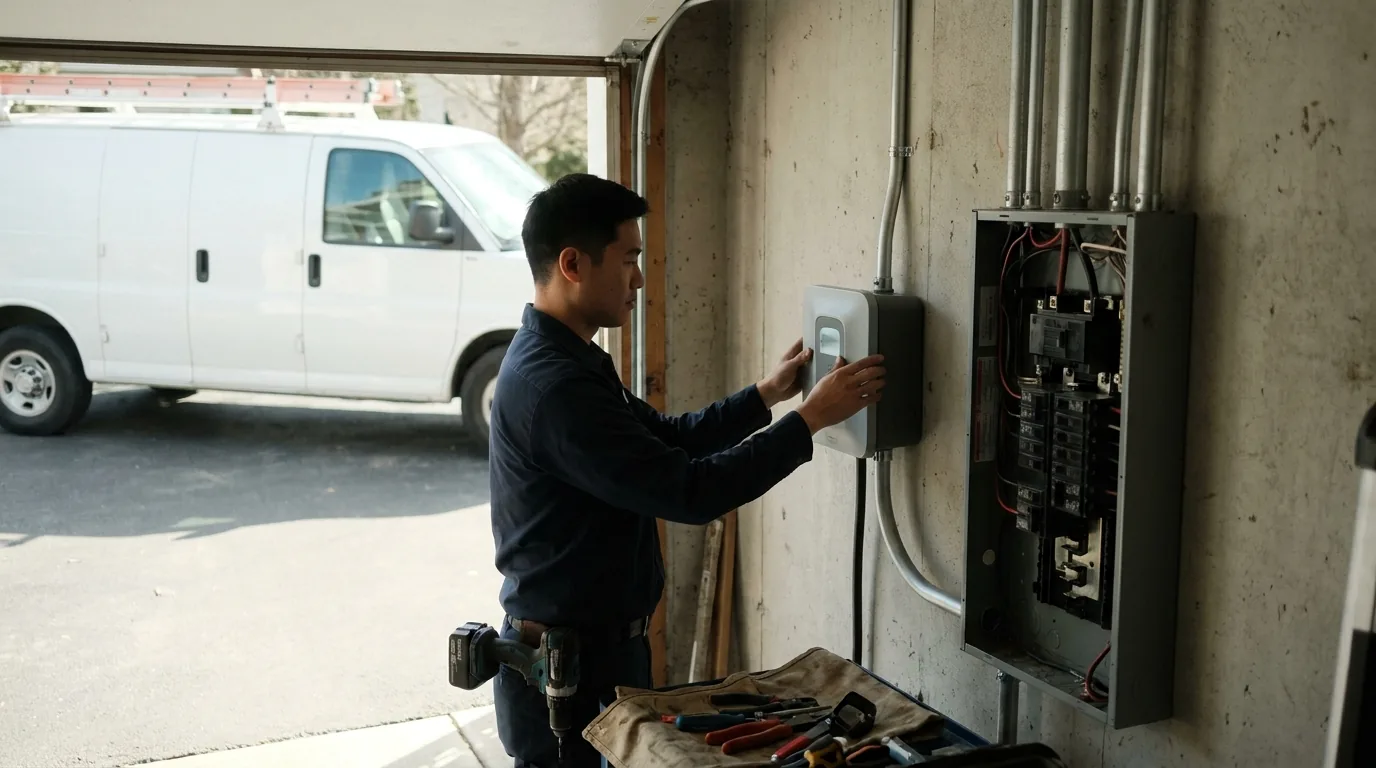
Walk the garage and photograph the panel plus meter plus proposed charger location plus planned cable run. Run your own panel-load numbers for existing load plus the new 60-amp EV circuit and log the result. Customer picks Tesla Wall Connector for $475 hardware plus $1,010 install for $1,485 or ChargePoint Home Flex for $699 plus $1,010. Build the quote in 6 minutes. Subtract IRA 30C credit of $400 and PG&E rebate of $500 for $585 net. Customer signs digitally and pays a 25 percent deposit before you back out of the driveway.
Panel Load Numbers on the QuoteStarter
Claver doesn't run the NEC load calculation for you. You still do that math yourself. But once you know the panel is at 78%, 85%, or 92% of capacity, log it on the quote as a custom field, price the load-management device or the 200-amp service upgrade right there, and the customer sees the full number before you show up Saturday. No "the panel won't take it" surprise at install.
1-Visit Install DispatchCrew
Materials arrive Friday. Saturday morning the tech arrives with the Tesla Wall Connector or ChargePoint plus the 60A 2-pole breaker. He brings the 6/3 NM-B cable or 6 AWG THHN in conduit for outdoor runs plus the wall-mount bracket and hardware. The job takes 2 to 3 hours total. The customer's car charges that night.
Photo Records for Utility RebateCrew
Pre-install photos show the panel plus meter plus proposed charger location with measurements. During-install photos show the breaker installed plus cable run secured plus wall mount and charger installed. Post-install photos show the installed charger with model and serial visible. Export the set as a branded photo report PDF to hand the customer for whatever rebate paperwork her utility requires.
Google Ads and Lead Source ROIBusiness
EV charger keywords cost $25 to $50 per click. Claver captures the Google Ads click ID and follows it through quote to signed contract to final payment. For example, "Tesla Wall Connector installer [city]" might generate a strong run of clicks, quotes, and signed jobs, while "EV charger installer near me" generates far more clicks but almost no revenue. Fund the first keyword harder. Cut the second.
Starter is $19/mo. Texting, AI and dispatch start on Crew at $39. The phone line and AI receptionist are on Business at $79.
Why EV charger installers switch
Why EV charger installation companies choose Claver
The fastest-growing electrical category
EV charger installation is the fastest-growing residential electrical category. Every Tesla and Rivian and Ford F-150 Lightning and Hyundai Ioniq 5 owner needs a Level 2 charger at home. The IRA's 30C tax credit puts $1,000 max on the install. Most state utilities layer their own $200 to $1,500 rebates on top. The shops that win are the ones who quote on-site with all three numbers built into the price. This lets the customer see the $585 net instead of the $1,485 retail.
The shops that win do two things differently. They price the panel-load math into the quote on-site, so they know whether the install fits or needs a service upgrade before they show up to install. This avoids a surprise $2,800 panel on Day 1. They also hand the customer clean install documentation for whatever rebate paperwork her utility requires, instead of scrambling to find photos three weeks later.
The on-site quote with tax credit and rebate math is the engine. Getting the panel math right up front is what protects the install from a $2,800 surprise.
When you walk Mrs. Castillo's San Francisco Marina garage on a Sunday morning her new Tesla Model Y arrives Tuesday. The proposal builds itself in the app. Photograph the existing panel, a 200A Square D QO from a 1998 install in the garage. Photograph the meter, PG&E 200A residential service. Photograph the proposed charger location on the interior wall of the garage, 6 feet from the parking spot, and the 32-foot planned cable run. You do the load calculation yourself the way you always have, existing dwelling load plus the new 48A continuous EV circuit, and confirm it fits under the panel's capacity without an upgrade. Log the result on the quote. Customer picks the Tesla Wall Connector for its native app integration. Build the quote for $1,485, including the $475 Tesla Wall Connector and $1,010 install labor, cable, conduit, breaker, wall mount, and permit. Subtract the IRA 30C tax credit of $400 and the PG&E EV charger rebate of $500 for $585 net to the customer. Customer sees the breakdown. She signs digitally and pays a $371 deposit. Install Saturday morning. Tesla charges Saturday night.
Pricing panel math into the quote
Getting the panel math onto the quote up front is what protects the customer from a $2,800 surprise on Day 1. Most EV charger installers eyeball the panel and quote $1,485 without running the numbers. Then Saturday morning the tech opens the panel and realizes the service is close to its limit once the pool pump, spa, heat-strip HVAC, and new EV charger are all accounted for. The tech tells the customer she needs a panel upgrade first for $2,800 more, after the deposit is spent. Claver doesn't run the load calculation for you, but once you've done the math on-site during the quote, you log whatever you find right there: if the circuit fits cleanly, price the install as quoted; if you need a load-management device, quote it now; if you need a service upgrade, quote that too. The customer sees the all-in number on Sunday and signs Sunday. Install proceeds Saturday without surprises.
Dispatch is what makes the 2 to 3 hour install profitable as a single trip. Materials arrive Friday at the customer's house, the charger, breaker, cable, conduit, and mounting hardware. Saturday morning the tech arrives, opens the panel, runs the circuit, mounts the charger, and activates it through the manufacturer's own app. He hands her the keys after a quick handshake test with her car. The job takes 2 to 3 hours total. Customer charges that night. One trip, one tech, one paid invoice.
Photo and commissioning documentation
Photo documentation is what makes your rebate paperwork easy to put together. Claver structures every install around timestamped photos. Pre-install photos show the panel, meter, and proposed charger location with measurements. During-install photos show the breaker installed, the cable run, and the mounted charger. Post-install photos show the installed charger with the model number and serial visible. Export the set as a branded photo report PDF. Claver doesn't file anything with your utility or the IRS, so whatever your customer's rebate program or Form 8911 requires is still on you or her tax preparer to submit, but you're handing over clean documentation instead of scrambling for it later.
And here is where most EV charger installers fly blind regarding marketing spend. You are paying $25 to $50 per click on Google Ads for keywords like Tesla Wall Connector installer city and EV charger install. Some clicks become $585-net Tesla Wall Connector installs with rebates. Some become $4,800 service-upgrade-plus-charger jobs. Some become nothing. Claver captures the Google Ads click ID when someone visits your site and tracks it through quote to signed contract to final payment. For example, "Tesla Wall Connector installer San Francisco" might generate a strong run of clicks, quotes, and signed jobs, while "EV charger installer near me" generates far more clicks but almost no revenue. Fund the first keyword harder and cut the second.
Cancel anytime. 20-minute migration from your current tool.
Pricing
Pricing that works for EV charger installers
$19/mo to start. $39/mo for growing teams. $79/mo for the full toolkit including AI summaries and app phone line and on-site quoting with IRA and rebate math and 1-visit install dispatch and photo documentation and Google Ads ROI. Same plans as every Claver page with no EV charger upsell.
Simple pricing, users included
Every plan includes unlimited jobs, quotes, invoices, and Stripe payments. Texting, AI, dispatch and job costing start on Crew. The phone system and full back office are on Business.
Starter: $1 for 14 days, then $19/mo. · Cancel anytime · Your data exports as CSV
Common questions
Common EV charger installer software questions
No marketing dance. The questions EV charger installers ask before they sign up.
Does Claver build on-site quotes with IRA 30C tax credit + utility rebate?+
Yes. Walk the garage with the customer. Photograph the panel + meter + proposed charger location + planned cable run. Customer picks charger (Tesla Wall Connector $475 + install = $1,485 OR ChargePoint Home Flex $699 + install). Build the quote in 6 minutes, minus IRA 30C tax credit ($400 = 30% of $1,485 capped at $1,000) minus utility rebate ($500 PG&E EV charger rebate or local equivalent) = $585 net to the customer. Customer signs digitally and pays a 25% deposit through Stripe before you back out of the driveway.
Does it run NEC 220.83 panel load calculations for me?+
No. Claver doesn't do the load calculation for you, that's still on the electrician doing the math on-site. What it does do is give you a place to log the result and price it into the quote right there: if the circuit fits, price the install as quoted. If you need a load-management device or a service upgrade, add that line item before the customer signs, not after your tech is already in the panel.
Does it document the install for utility rebate paperwork (PG&E, ConEd, Eversource)?+
Yes, with photos and a branded PDF report. Claver structures every install around timestamped photos: pre-install panel + meter + proposed charger location with measurements, during-install photos of the breaker, cable run, wall mount, and charger installation, post-install photo with the model number and serial visible. Export the set as a photo report PDF. Claver doesn't submit anything to your utility or the IRS. Filing the rebate application or Form 8911 is still on you or the customer's tax preparer, but you're handing over clean documentation instead of digging for it later.
Can I import customers from ServiceTitan, Housecall Pro, or Jobber?+
Yes. Export your customer list as CSV from your current tool, ServiceTitan, Housecall Pro, Jobber, FieldEdge, and upload it to Claver. The wizard maps the columns. Most EV charger installers finish the migration in 20-30 minutes. We'll personally help if anything looks off. Email [email protected].
What does Claver cost for an EV charger installer?+
$19/mo for Starter (2 users), with on-site quoting and IRA and rebate math included. $39/mo for Crew (8 users) when you want texting, AI, dispatch, and photo documentation. $79/mo for Business with the full toolkit, including Google Ads conversion tracking. No contract. Cancel anytime.
Your current software owns your customer list. We don't want to.
Leave whenever you want. Your customers, jobs, and invoices export to CSV the day you go. Payments run through your own Stripe account, not ours.